We design and manufacture commercial rope playground equipment for parks, schools, communities, resorts, amusement parks and indoor recreation venues. From climbing towers and suspended bridges to crawling tunnels and obstacle routes, each system can be planned around the available space, target age group and intended level of challenge.
A playground with ropes does not have to be a standalone net. Rope elements can connect metal frames, wooden towers, platforms, slides and themed structures to create a more varied play route.
Send us your site dimensions, project location, target users, budget and preferred activities. We can prepare a preliminary rope playground layout for your project.
Rope Playground Equipment for Different Ways to Play
3D Climbing Nets and Net Towers
Three-dimensional nets allow children to move upward, across and through the structure instead of following one fixed route. Designs can range from compact central-mast climbers to larger multi-level rope playground structures.
Our Net Tower Play System uses interwoven ropes around a central pillar to create a cone- or tower-shaped climbing structure.
Rope Bridges and Suspended Crossings
Rope bridges connect platforms, towers or separate play zones. Depending on the layout, they can be level, inclined or combined with hand ropes and other supporting elements.
Because the surface moves underfoot, the crossing creates a different experience from a rigid stairway or bridge.
Rope Tunnels and Crawling Routes
Horizontal or inclined rope tunnels can create enclosed-looking routes without using solid walls. They work well between towers, inside themed playgrounds or as part of a longer climbing sequence.
The tunnel diameter, length, inclination and access points should be selected according to the intended users and surrounding structure.
Rope Obstacle Routes
Suspended steps, rope crossings, nets and balance elements can be arranged as a connected obstacle route. The sequence can be kept relatively simple or developed into a more demanding adventure course.
The operating model must be confirmed early. A free-play rope structure and an elevated course that requires harnesses, staff supervision and controlled access are different types of projects.
Rope Elements in Mixed-Material Playgrounds
Rope play equipment can also be incorporated into a larger playground rather than installed as a separate structure. Common combinations include:
Rope nets connected to metal towers
Rope bridges between wooden platforms
Net climbing routes leading to plastic or stainless steel slides
Rope tunnels inside themed play structures
Suspended obstacles within indoor activity spaces
Rope Play Structure, Rope Course or Ninja Course?
These terms are sometimes used interchangeably, but they describe different operating experiences.
| Type | Typical Format | Operating Considerations |
| Rope playground structure | Net tower, rope bridge, tunnel or connected climbing net | Designed as part of a conventional free-play playground |
| Harnessed rope course | Elevated obstacles and suspended routes | May require harnesses, controlled entry, trained staff and specific operating procedures |
| Ninja course | Sequential obstacle and fitness-style challenges | Focuses more on completing a route, speed or physical challenge |
Rope Playground Structures Projects
1. Rainbow Rope Climbing at MGM Qingdao Playland
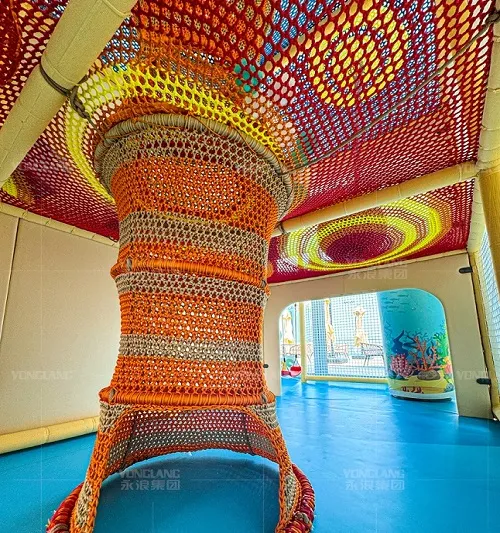
At MGM Qingdao Playland, our Xuanda Play team created a colorful woven climbing structure shaped like a rainbow tunnel. Its multi-layer layout allows children to grip, climb and move between different elevations while maintaining open visibility through the play area.
The rope installation is part of a larger themed indoor playground, showing how rope can become both a play route and a strong visual feature.
2. Multi-Level Indoor Rope Course
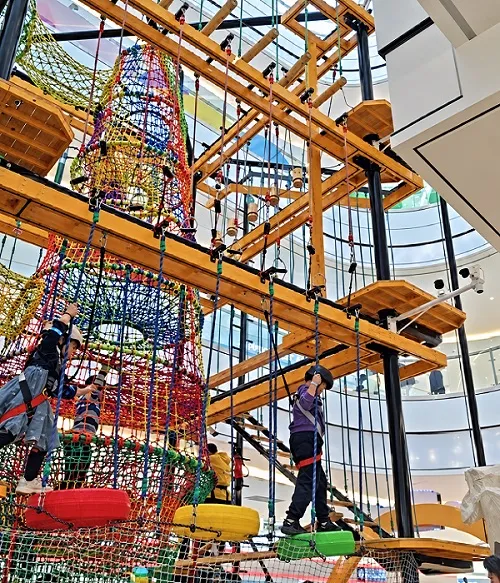
Our mall-based Indoor Rope Course combines colorful nets with elevated suspended obstacles and secure harnesses. It is an example of a supervised adventure experience rather than a conventional free-play net.
This distinction affects the layout, user flow and operating requirements, so the intended business model should be confirmed at the beginning of the project.
3. Rope Climbing Playground Equipment for Garden
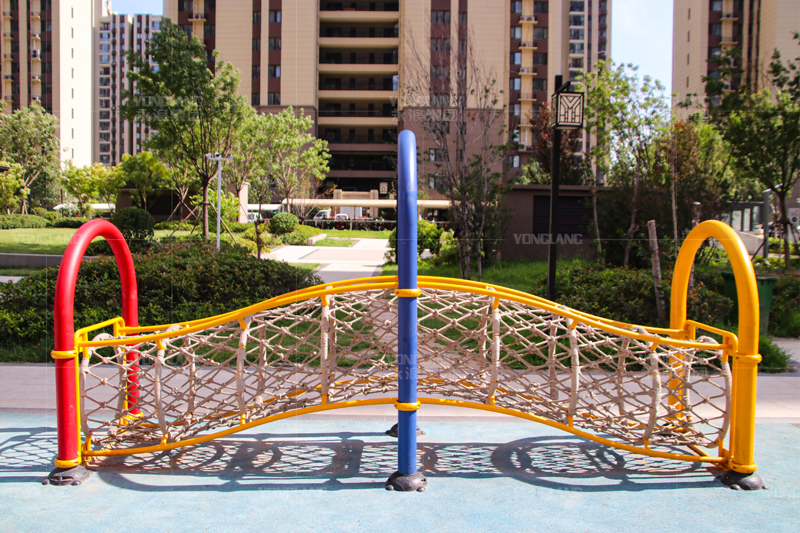
This outdoor playground at Shandong Country Gardenuses rope play as an important part of the activity experience. Rope nets and bridge-style climbing structures create routes where children can climb, cross, balance, and move between different points of the play area.
The rope elements are combined with slides, spring riders, and musical play equipment, giving children different ways to stay active within the same space. For community and residential projects, this type of rope playground can add more physical challenge without requiring a large standalone play structure.
Inspection and Maintenance of Rope Play Equipment
Rope equipment should be included in the playground’s routine inspection and maintenance plan.
Inspect Rope Surfaces
Check for cuts, abrasion, broken strands, deformation, unusual looseness or other visible damage, especially in high-contact areas.
Check Tension and Net Shape
Look for excessive sagging or changes in the intended net geometry. Any required adjustment should follow the product’s maintenance instructions.
Inspect Connections and Supporting Structures
Check connection points, fittings, frames, posts and anchors for looseness, movement, corrosion or impact damage.
Review Surfacing and Clearances
Inspect the surfacing beneath and around the equipment and keep the designated movement and fall areas free from obstacles.
Record and Respond to Damage
Keep records of inspections, adjustments and replacement parts. If damage could compromise a rope, connection or supporting structure, restrict access to the affected equipment until it has been assessed and repaired.
Inspection frequency should reflect equipment use, environmental exposure, local requirements and the maintenance instructions supplied with the selected product.
FAQs About Rope Playground Equipment
What are playground climbing ropes made of?
Materials vary by product. Our Interwoven Rope Net Structures use 16 mm marine-grade rope nets with a galvanized steel-tube frame; other configurations may use different specifications.
What is rope playground equipment?
Rope playground equipment includes climbing nets, net towers, rope bridges, tunnels, suspended crossings and obstacle routes. Rope may form the main structure or connect other playground components.
Is a rope playground the same as a rope course?
No. A conventional rope playground is generally used as free-play equipment. A rope course may include higher suspended obstacles, harnesses, controlled access and staff supervision.
What age is rope playground equipment suitable for?
There is no single age range for every rope structure. Tall spatial nets and more demanding climbing routes are generally better suited to school-age children, while lower and simpler layouts can be planned for younger users.